When Billing Stops Feeling Fair: A Client Centered Look at AI in Divorce Cases from a Divorce Coach’s Perspective
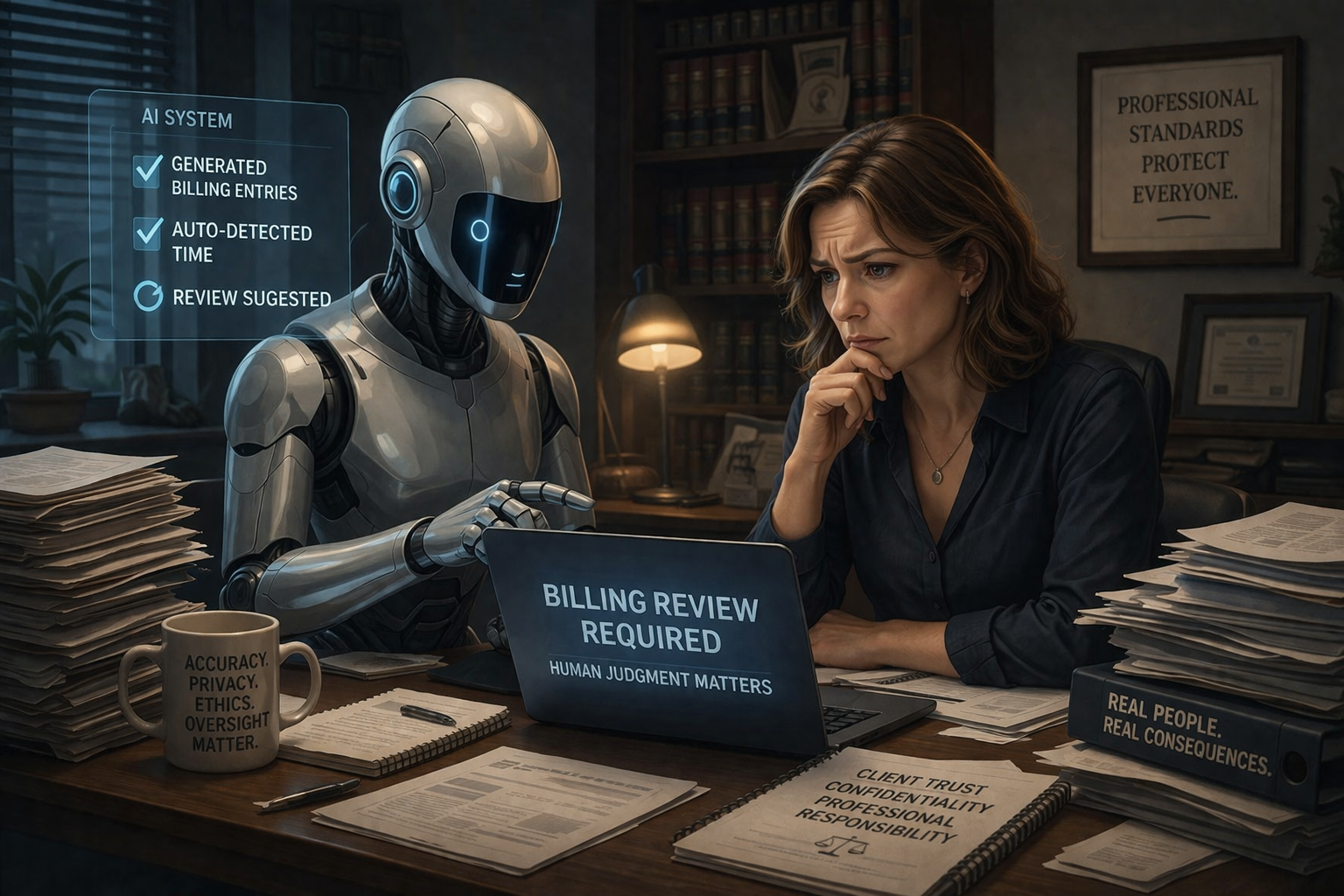
I want to talk about something I am starting to notice more often with clients.
And I want to be clear about where I am coming from. I am not an attorney, and I am not speaking from inside a law firm. I work directly with people going through high-conflict divorce, and I hear what their experience actually feels like on the other side of the process.
This is also not about rejecting technology. There are a lot of attorneys who care deeply about their clients and are doing their best to manage a lot at once.
But there is a shift happening that I think deserves attention, especially when it comes to AI being used in billing and communication.
Because this is not just about efficiency.
It is about trust.
It is about fairness.
It is about how clients experience the process during an already overwhelming time.
1. AI Doesn’t Understand Context
AI does not understand what is meaningful work and what is not.
It follows instructions.
So when a system is designed to capture all activity that could be billed, it may pick up things like internal emails or quick acknowledgments.
“Thanks.”
“Got it.”
Brief coordination messages.
Let’s be honest. In-house emails between staff, including back-and-forth communication between paralegals, should not be billed at the level that can happen when AI is capturing everything automatically.
From a system perspective, that might look like activity.
From a client perspective, that can feel confusing.
Because there is a difference between true legal work and background communication that supports it.
And that distinction matters.
2. Clients Are Paying Attention
Clients are reading their invoices more closely than ever.
They are asking questions.
They are comparing experiences.
They are trying to understand what they are being charged for.
When they see repeated small entries for things they were not part of, it can start to feel uncomfortable.
Not always because of the amount, but because of what it represents.
It can feel like a lack of transparency.
And once that feeling sets in, it can change how they view the entire relationship.
3. When It Goes Too Far
I recently saw a situation where someone was initially quoted around $2,000 to $3,000 for what was expected to be a relatively limited legal task.
By the time billing was finalized, the total was close to $12,000.
When the billing was reviewed more closely, there were multiple discrepancies. Some entries did not align with the actual work performed, and in some cases even appeared to reference entirely different cases, including what looked like someone else’s case.
From the client’s perspective, it felt disconnected from their case altogether.
And that raises an even more serious concern.
If information from another client’s case is showing up in someone else’s bill, that is not just a billing issue. That is a confidentiality issue.
Clients trust that their personal and legal information is being handled with care and kept private. When that boundary is crossed, even unintentionally, it undermines that trust in a significant way.
This was not a complex, drawn-out situation that would reasonably explain that kind of increase. It was supposed to be a contained legal task with a fairly predictable range.
What stood out most was not just the amount. It was the lack of alignment between what was initially communicated and what was ultimately billed.
And more importantly, there was no clear evidence of meaningful oversight. The output itself became the final word.
The client lost trust.
And ultimately, they made the decision to end the relationship.
Because when a client feels like no one is stepping back to look at the full picture, it creates a level of uncertainty that is very hard to move past.
Situations like this are exactly why oversight matters. Not just for accuracy, but for protecting client trust and confidentiality.
4. Does It Really Save Time?
There is an assumption that AI makes things more efficient.
But when it comes to billing, there still needs to be human review.
Someone has to look at what was generated.
Make sure it is accurate.
Remove anything that does not belong.
That process takes time and attention.
So it raises a fair question about whether the benefit is as clear as it seems.
5. Privacy Is Worth Thinking About
Many of these tools work by scanning emails and documents.
That means sensitive information is being processed through systems that are not always fully visible to the client.
For people going through high-conflict divorce, the information being shared is often deeply personal.
So it is reasonable to ask:
Where is that information going?
How is it being handled?
Who has access to it?
Clients may not always know to ask those questions, but they still matter.
6. Accountability Still Matters
No matter what tools are being used, the responsibility for billing decisions does not change.
If a client has concerns, they are not going to separate the technology from the professional.
They are going to look to the person they hired.
Which is why oversight and intention are so important here.
And this is where it matters to say something clearly.
If AI is being used in a way that inflates billing without careful review, that is not a technology issue. That is a professional responsibility issue.
It is also important to recognize the position many clients are in. Most people going through a divorce have never been through this process before. They do not always know what is appropriate to question on a legal bill, even when something feels off.
They can feel it.
They can sense the disconnect.
But they may not know how to advocate for themselves in that moment.
And that can leave them feeling frustrated, overwhelmed, and sometimes completely deflated.
At the same time, attorneys are held to clear standards when it comes to billing practices. Padding or inflating bills is something that is taken seriously by the bar.
Using AI does not change that.
It does not lower the standard.
And it does not shift the responsibility.
If anything, it raises the need for careful, thoughtful oversight to ensure that what is being billed is fair, accurate, and aligned with the work actually performed.
The Bottom Line
This is not about being for or against AI.
It is about making sure that the human element is not lost in the process.
From a client perspective, billing is not just a line item.
It is part of how trust is built or broken.
And in high-conflict situations, that trust already feels fragile.
Clients want to feel like someone is paying attention.
Like someone is being thoughtful about their case and their resources.
That matters just as much as the outcome.
If you are an attorney reading this, this is simply something to reflect on.
Not from a place of criticism, but from the client experience side of things.
Because how something feels to a client is often just as important as how it functions behind the scenes.
References and Further Reading
Woolf, 2026. The Ethics of Generative AI and Legal Billing
Attorney at Work, 2025. AI and Legal Billing Practices: Be Reasonable, People!
Florida Bar Ethics Opinion 24-1 (2024)
American Bar Association Formal Opinion 512
ABA Model Rule 1.5, Comment 5